Skip to content

Circular Economy Podcast - Episodes

180 Catherine Weetman – the ripple effect

180 Building the business case for circularity: the ripple effect

We’re thinking about the business case: how the circular economy addresses the problem—reducing negative impacts from business—and how it provides benefits – or, in business terminology – how it provides “value”. One way of looking at that is to think about the return we get on our manufactured assets—all the products and packaging we send out through the factory gate. When we look at value, we can think about different aspects, including creating value and retaining existing value in products and materials, as well as how our solution might avoid the destruction of value, compared to existing, linear alternatives. We'll look at why it's important to design solutions that solve real problems and make a positive impact along the whole…
Recent episodes

180 Catherine Weetman – the ripple effect

180 Building the business case for circularity: the ripple effect

We’re thinking about the business case: how the circular economy addresses the problem—reducing negative impacts from business—and how it provides benefits – or, in business terminology – how it provides “value”. One way of looking at that is to think about the return we get on our manufactured assets—all the products and packaging we send out through the factory gate. When we look at value, we can think about different aspects, including creating value and retaining existing value in products and materials, as well as how our solution might avoid the destruction of value, compared to existing, linear alternatives. We'll look at why it's important to design solutions that solve real problems and make a positive impact along the whole…
179 Dimitri Naczaj

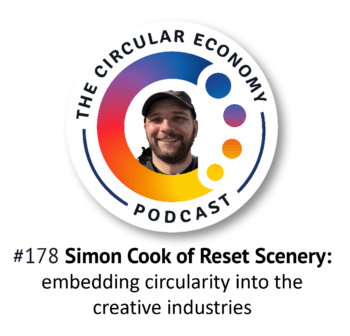
179 Dimitri Naczaj: using behavioural science to bridge the “say-do” gap

Dimitri Naczaj is a behavioural scientist and founder of Bellegarde Scientific Consulting, a research-based consultancy applying behavioural science to the challenges of the circular economy. His work focuses on understanding and changing human behaviour towards sustainable habits, such as sorting for recycling, repair and reuse, and participation to return programs. Dimitri and his colleagues design evidence-based interventions that make circular systems work in practice, on a behavioural level. Since his Ph.D., Dimitri has worked extensively on electronic devices, including collection, repair and reuse. As Dimitri explains, behavioural science helps us find ways to bridge the "say-do" gap, the gap between intentions and actions, so we can encourage circular and sustainable behaviours. Dimitri outlines three ‘moments’ of circular economy behaviours: before…
178 Simon Cook Reset Scenery

178 Simon Cook of Reset Scenery: embedding circularity into the creative industries

Simon Cook is co-founder of Reset Scenery, a Scotland-based organisation working at the intersection of the creative industries and the circular economy. Simon has over 25 years in set construction and more than a decade focused on circular practice, and works to reduce waste in the creative industries by reclaiming, repurposing and rethinking scenic fabrication. Through Reset Scenery’s circular programmes, material recovery systems and industry advocacy, Simon champions practical, scalable approaches to sustainable fabrication for stage, screen and live events. Reset Scenery supports the Stage, Screen & Events sectors through reclaimed material redistribution, circular material management strategies and lower-impact construction approaches aligned with initiatives such as the Theatre Green Book. Simon and his co-founder, Matt Doolan are focusing on how…
Rethink loop

Get in touch to arrange a call