Podcast: Play in new window | Download
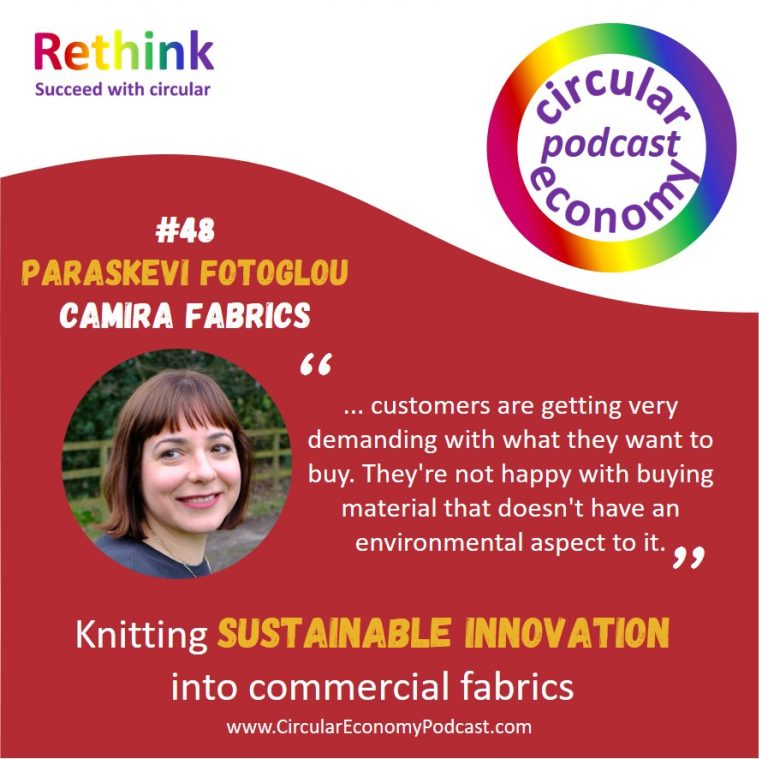
Catherine Weetman talks to Paraskevi Fotoglou, Sustainability Engineer at Camira Fabrics, a UK textile manufacturing company for task and soft seating.
Paraskevi has expertise in circular economy projects and innovative design ideas. She is exploring new sustainability paths and enhancing circular initiatives with the design, innovation and manufacturing teams across the business.
At Camira she has developed a broad knowledge on environmental accreditation, VOC emissions, the use of chemical substances used within each stage of fabric manufacture, and the incorporation of sustainable fibres.
We talk about some of the sustainable fabric developments from natural and recycled fibres, ‘Technical Knitting’, how Camira is developing Environmental Product Profiles, and why sustainability isn’t enough to engage customers and build a successful business.
Podcast host Catherine Weetman helps businesses use circular, regenerative and fair solutions to do better, with less.
Stay in touch for free insights and updates…
Read on for more on our guest and links to the people, organisations and other resources we mention.
Links we mention in the episode
- Camira website: Camira Fabrics | Contract Fabrics for Commercial Interiors – Camira Fabrics
- Camira on LinkedIn Camira Fabrics Limited: My Company | LinkedIn
- Bast-Fibre-Brochure-2019_WEB (camirafabrics.com)
- Oceanic-Storycard-UK (camirafabrics.com)
- SEAQUAL INITIATIVE – Together for a Clean Ocean
- Big Closet, Small Planet podcast episode on the issues of chemicals used in textile production, with Phil Patterson, Managing Director at Colour Connections https://www.sustainablefashionacademy.org/podcasts/big-closets-small-planet/make-your-case-phil-patterson-circular-chemical-management
- Article from OECOTextiles on Volatile Organic Compounds https://oecotextiles.blog/2010/03/17/volatile-organic-compounds-vocs/
About Paraskevi Fotoglou
Paraskevi is Sustainability Engineer at Camira Fabrics, a West Yorkshire based textile manufacturing company for task and soft seating, with expertise in circular economy projects and innovative design ideas.
Paraskevi’s principal focus is exploring new sustainability paths and enhancing circular initiatives with the design, innovation and manufacturing teams across the business. At Camira she has developed a broad knowledge on environmental accreditation, VOC emissions, the use of chemical substances used within each stage of fabric manufacture, and the incorporation of sustainable fibres. An exciting venture for 2021 is a project focused on conducting Environmental Product Profiles for both Camira’s natural and synthetic fabric offering, enabling the business to better measure and describe their environmental footprint.
Paraskevi’s background is diverse as she has been living and studying in different countries the last 10 years. She studied statistics and holds a master’s degree in Economic Development and Sustainability.
About Camira Fabrics
Camira’s circularity journey started in 1998 with a fabric made from recycled military woollen jumpers, this concept was then expanded to include closed and open loop recycled polyester textiles and the latest innovation achievement is the incorporation of plastic sea waste included in the raw material used to manufacture SEAQUAL yarn. The Oceanic fabric range developed by Camira is created entirely from post-consumer recycled plastic, diverting plastic bottles which would usually be destined for landfill, coupled with discarded plastic debris that is currently floating in our seas (SEAQUAL yarn).
Camira has also received recognition for the pioneering design and manufacture of the Bast Fibre Collection. The bast fibre ranges are made from innovative blends of pure new wool combined with naturally occurring textile fibres derived from harvested nettles, hemp and flax. Aside from the obvious environmental benefits of using such alternative fibres, the blends meet high flammability standards without the use of additional chemicals and without compromising their recyclability at the end of the use.
If you’re new to the circular economy, you might like the ‘getting started’ playlist. There’s also an interactive podcast index, making it easy to find episodes on each of the key circular economy strategies or for a specific market sector. And to dig deeper, please check out Catherine’s award-winning A Circular Economy Handbook, published by Kogan Page.
Please follow the Circular Economy Podcast and let us know what you think on LinkedIn, and if you love this episode, please leave us a review wherever you listen, or send an email…