Podcast: Play in new window | Download
We’re thinking about the business case: how the circular economy addresses the problem—reducing negative impacts from business—and how it provides benefits – or, in business terminology – how it provides “value”.
One way of looking at that is to think about the return we get on our manufactured assets—all the products and packaging we send out through the factory gate.
When we look at value, we can think about different aspects, including creating value and retaining existing value in products and materials, as well as how our solution might avoid the destruction of value, compared to existing, linear alternatives.
We’ll look at why it’s important to design solutions that solve real problems and make a positive impact along the whole supply-chain for 3 dimensions of affected parties: including the business, its workers, supply chain partners and investors, as well as future generations.
But those who we need to support this, to buy into the business case, and to buy the product or service itself, may not be aware that there is a problem. For example, does everyone know how chemicals in plastics and other products are affecting human health?
And, even if they’re aware of the problem, they may not think that solutions are possible – or, know where to find them. As we’ll hear, that’s where behavioural change and Schwartz’s concept of the ‘buyer’s journey’ can be game-changers.
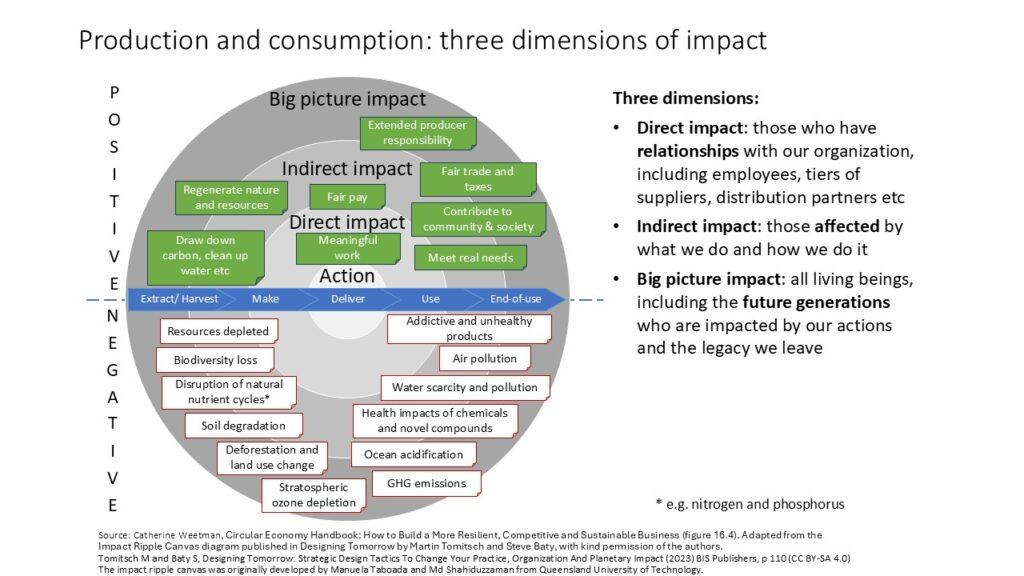
Here’s Catherine’s adaptation of the Impact Ripple Canvas, from the 3rd edition of A Circular Ecomomy Handbook – see links below for a discount on the book, and a link to the tool and book that inspired it, Designing Tomorrow by Martin Tomitsch and Steve Baty (adapted with kind permission of the authors)
Podcast host Catherine Weetman helps businesses use circular, regenerative and fair solutions to do better, with less.
Stay in touch for free insights and updates…
Read on for more on our guest and links to the people, organisations and other resources we mention.
Books, people and organisations mentioned
- Circularity Gap Reports https://circularity-gap.world/global
- A Circular Economy Handbook: How to Build a More Resilient, Competitive and Sustainable Business is available from any good bookseller, or direct from the publisher Kogan Page, which ships worldwide (free shipping to UK and US). Discount code KOGANPAGE25 gives you 25% off the book at https://www.koganpage.com/CircEcon3. This offer also applies to Kogan Page’s bundle option (print plus e-book for the same price as the print edition).
- Designing Tomorrow https://www.designingtomorrowbook.com/
- Impact Ripple Canvas, from Tomitsch M and Baty S, Designing Tomorrow: Strategic Design Tactics To Change Your Practice, Organization And Planetary Impact (2023) BIS Publishers, p 110 (CC BY-SA 4.0) https://www.designingtomorrowbook.com/resources?pgid=lqfzjq0v-f70dda11-d276-44b7-9c8e-90b9c865fa78
- Impact Ripple Canvas, adapted by Catherine Weetman to highlight positive and negative impacts along the lifecycle – downloadable PDF here.
- 155 Martin Tomitsch and Steve Baty: Life-centred design. Martin Tomitsch and Steve Baty, authors of Designing Tomorrow, explain why we need to shift towards life-centred and strategic design https://www.rethinkglobal.info/155-martin-tomitsch-and-steve-baty-life-centred-design/
- 154 Loic Le Fouest of Clarasys: creating circular customer experiences – https://www.rethinkglobal.info/154-loic-le-fouest-of-clarasys-designing-circular-customer-experiences/
- 179 Dimitri Naczaj: using behavioural science to bridge the “say-do” gap – https://www.rethinkglobal.info/179-dimitri-naczaj-behavioural-science/
- 178 Simon Cook of Reset Scenery: embedding circularity into the creative industries – https://www.rethinkglobal.info/178-simon-cook-of-reset-scenery
- 177 Dan Dicker: moving the dial on reusable cup systems – https://www.rethinkglobal.info/177-dan-dicker-reusable-cup-systems/
- 176 Katie Allen: why healthy clothing starts with healthy soils – https://www.rethinkglobal.info/176-katie-allen-healthy-clothing-starts-with-healthy-soils/
- 175 Stephen Fitzpatrick: remanufacturing as a strategic capability – https://www.rethinkglobal.info/175-stephen-fitzpatrick-remanufacturing-as-strategic-capability/
- Episode 174 Sydney Harris and Jennifer Carrigan of Upstream: effective, equitable reuse systems – https://www.rethinkglobal.info/174-upstream-effective-equitable-reuse-systems/
- 173 Giulio Bonazzi of Aquafil – pioneering regenerative nylon – https://www.rethinkglobal.info/173-giulio-bonazzi-of-aquafil-econyl-regenerative-nylon/
- 172 Tom Llewellyn of Shareable: how sharing and cooperative projects help us thrive (in two parts) – https://www.rethinkglobal.info/172-tom-llewellyn-of-shareable-part-1/ and https://www.rethinkglobal.info/172-tom-llewellyn-of-shareable-part-2/
- Patrick Schröder: circular economy policymaking – progress and barriers – https://www.rethinkglobal.info/171-patrick-schroder-circular-economy-policymaking/
If you’re new to the circular economy, you might like the ‘getting started’ playlist. There’s also an interactive podcast index, making it easy to find episodes on each of the key circular economy strategies or for a specific market sector. And to dig deeper, please check out Catherine’s award-winning A Circular Economy Handbook, published by Kogan Page.
Please follow the Circular Economy Podcast and let us know what you think on LinkedIn, and if you love this episode, please leave us a review wherever you listen, or send an email…