Podcast: Play in new window | Download
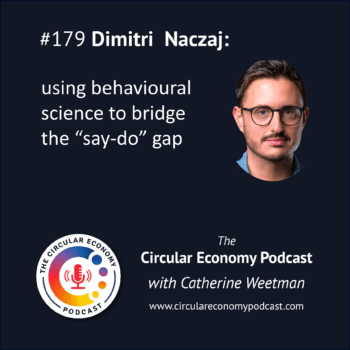
Dimitri Naczaj is a behavioural scientist and founder of Bellegarde Scientific Consulting, a research-based consultancy applying behavioural science to the challenges of the circular economy. His work focuses on understanding and changing human behaviour towards sustainable habits, such as sorting for recycling, repair and reuse, and participation to return programs.
Dimitri and his colleagues design evidence-based interventions that make circular systems work in practice, on a behavioural level. Since his Ph.D., Dimitri has worked extensively on electronic devices, including collection, repair and reuse.
As Dimitri explains, behavioural science helps us find ways to bridge the “say-do” gap, the gap between intentions and actions, so we can encourage circular and sustainable behaviours.
Dimitri outlines three ‘moments’ of circular economy behaviours: before using, while using, and after using, and explains how our choices are influenced by a variety of factors including environmental awareness, or personal values, and information transparency.
We discuss how behavioural science can support circular options such as repairing, sharing and returning products at the end of life, and if you’d like to learn more, Dimitri recommends three books to read.
Podcast host Catherine Weetman helps businesses use circular, regenerative and fair solutions to do better, with less.
Stay in touch for free insights and updates…
Read on for more on our guest and links to the people, organisations and other resources we mention.
Links for our guest:
- Dimitri Naczaj on Linkedin: https://www.linkedin.com/in/dimitrinaczaj/
- Bellegarde on Linkedin: https://www.linkedin.com/company/bellegarde-scientific-consulting/
- Bellegarde Website: https://bellegarde.co
- Contact: naczaj@bellegarde.co
Books, people and organisations we mentioned
Research papers:
- Parajuly, K., Green, J., Richter, J., Johnson, M., Rückschloss, J., Peeters, J., Kuehr, R., & Fitzpatrick, C. (2024). Product repair in a circular economy: Exploring public repair behavior from a systems perspective. Journal of Industrial Ecology, 28, 74–86. https://doi.org/10.1111/jiec.13451
- Keshavarz, K., Alvarez, M.J. & Garcia, C.J. The Role of Consumers in Transitioning to a Circular Economy. Econ.Sust. 5, 4271–4295 (2025). https://doi.org/10.1007/s43615-025-00617-0
Books:
- Michael J. Sandel – What Money Can’t Buy: the moral limits of markets https://sandel.scholars.harvard.edu/publications/what-money-cant-buy-moral-limits-markets
- Matt Walleart – Start at the End: How to build products that create change https://mattwallaert.com/startattheend/ and his free 6 week behavioural science course https://mattwallaert.com/free-course/
- Susan Michie, Lou Atkins & Robert West – The Behaviour Change Wheel: a Guide To Designing Interventions https://www.behaviourchangewheel.com/
- Gillian Tett – Anthro Vision – how anthropology can explain business and life https://www.penguin.co.uk/books/441314/anthro-vision-by-tett-gillian/9781847942890
Other episodes on behaviour:
- Episode 126 – Ruth Taylor of the Common Cause Foundation explains how our personal values drive behaviour, and what that means for the circular economy transition. #126 Ruth Taylor: closing our circular values gap https://www.rethinkglobal.info/126-ruth-taylor-closing-our-circular-values-gap/
- Catherine’s blog – Can staying true to our personal values accelerate circular change? https://www.rethinkglobal.info/can-staying-true-to-our-personal-values-accelerate-circular-change/
- Episode 152 – Markus Terho explains how the Lifestyle Test app helps those concerned about global warming make simple, positive and sustainable changes. 152 Markus Terho: The Lifestyle Test https://www.rethinkglobal.info/152-markus-terho-the-lifestyle-test/
- Episode 154 – Loic Le Fouest, an expert in Customer Experience at Clarasys tackles customer engagement – a key challenge for circularity. 154 Loic Le Fouest of Clarasys: creating circular customer experiences https://www.rethinkglobal.info/154-loic-le-fouest-of-clarasys-designing-circular-customer-experiences/
Guest bio
Dimitri Naczaj is a behavioural scientist and founder of Bellegarde Scientific Consulting, a research-based consultancy dedicated to applying behavioural science to the challenges of the circular economy and sustainability transitions.
His work focuses on understanding and changing behaviour related to circularity: why devices are kept in drawers or discarded, what motivates participation in collection programs, or how producer responsibility organisations and producers should consider behaviour as the last link of the circular chain, completing strong infrastructure and regulation. Dimitri’s research and consulting projects analyse behavioural barriers across the value chain and design interventions that help circular systems work more effectively in practice.
At Bellegarde, they collaborate with private companies, PROs, public institutions and academic researchers to develop behavioural diagnostics, test interventions and translate scientific evidence into operational strategies. The consultancy works closely with internationally recognised scientists and applies methods from psychology, behavioural economics and social sciences to real-world circular economy challenges.
For the past 15 years, since his Ph.D., a significant part of Dimitri’s work has focused on electronic devices, where millions of products remain unused despite a growing demand for critical materials. It includes behaviours related to collection, recycling, reuse, and repair. His broader mission is to ensure that behavioural science becomes a core tool for making circular economy policies and systems actually work.
If you’re new to the circular economy, you might like the ‘getting started’ playlist. There’s also an interactive podcast index, making it easy to find episodes on each of the key circular economy strategies or for a specific market sector. And to dig deeper, please check out Catherine’s award-winning A Circular Economy Handbook, published by Kogan Page.
Please follow the Circular Economy Podcast and let us know what you think on LinkedIn, and if you love this episode, please leave us a review wherever you listen, or send an email…