Podcast: Play in new window | Download
We know plastic waste is a massive problem – but do we know how plastic is affecting our health? Catherine Weetman talks to Maria Westerbos about the groundbreaking work of the Plastic Soup Foundation.
Many of us are becoming increasingly aware of the amount of plastic in our lives – whether it is clothing and household textiles made from synthetic fibres like polyester, acrylic, lycra and so on, or the anti-crease finishes, flame retardants and other additives in those fibres. And of course, there’s plastic packaging, the outer cases of phones and laptops, and much, much more. Plastic has many useful properties: it can be moulded into complex shapes, it’s light weight, flexible, durable and so on.
But now, we’re realizing there are downsides to all this – what happens when plastic is discarded, and ends up causing pollution and harm to other living species – and also, how plastic, and the chemicals it contains, is affecting our health. We know plastic particles and microfibres are now found all around the world, and are contaminating our water and food – but what about our contact with plastics in our daily lives… they are in lots of personal care products, we wear them next to our skin, we eat food that’s been wrapped in plastic.
Maria Westerbos explains why we need to understand much more about the impact of plastics on our health, and how some of the organisations that exist to protect our health are – shamefully – looking the other way.
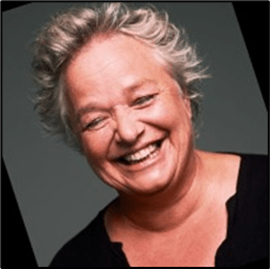
Maria is an expert in mass communication, and she’s used her background as a science journalist, her 25 years experience working in TV and her intuition to inspire social change.
In 2011 she set up Plastic Soup Foundation. With its first campaign, Beat the Microbead, the Foundation has succeeded in changing both the perceptions and use of microplastics by international businesses, local and national governments, consumers and NGOs.
We hear how Maria found the sweet-spot to engage people with making changes to their daily lives, including the Beat the Microbead app to help you check what’s behind the product label.
Podcast host Catherine Weetman helps businesses use circular, regenerative and fair solutions to do better, with less.
Stay in touch for free insights and updates…
Read on for more on our guest and links to the people, organisations and other resources we mention.
Links we mention in the episode:
- Plastic Soup Foundation and its campaigns have been featured extensively in top-tier titles including The Times, The Independent, The Daily Telegraph, Bild, The Daily Express, The Daily Mail, and Fast Company.
- Website: https://www.plasticsoupfoundation.org/en/
- And the Plastic Health Coalition https://www.plastichealthcoalition.org/
- Instagram: https://www.instagram.com/plasticsoupfoundation/
- Facebook: https://www.facebook.com/plasticsoupfoundationnl/
- Twitter: https://twitter.com/plasticsoupfoun
- LinkedIn: https://www.linkedin.com/company/plastic-soup-foundation/
- The report Maria mentioned, showing that almost 9 out of 10 products from major cosmetic brands contain microplastics: https://www.plasticsoupfoundation.org/en/2022/04/almost-9-in-10-products-from-major-cosmetics-brands-contain-microplastics/
- Professor Dr. Raymond Pieters’ paper https://www.plasticsoupfoundation.org/en/2021/11/plastic-particles-can-affect-our-immune-system/
- UNSSC Circular Economy 6-week online course – starts again in August 2022 https://www.unssc.org/courses/circular-economy-and-2030-agenda
About Maria Westerbos

Maria Westerbos is an expert in mass communication. She combines a taste for inspiring social change projects with strategic insight and near-flawless intuition covering a wide range of target groups.
Maria started as a science journalist but gradually became involved in the world of television. She worked for more than 25 years (primarily freelance) for broadcasting companies and production companies, initially as editor/researcher, but then as producer, production coordinator, editor-in-chief, executive producer, business-unit manager, delegated producer and creative producer.
In 2011 she set up Plastic Soup Foundation. With its first campaign, Beat the Microbead, the Foundation established change in the use of microplastics by international businesses, local and national governments, consumers and NGOs.
Maria is a flamboyant woman with a zest for life who is able to motivate groups with inspiring stories about taking a positive approach to complex problems for permanent change.
Plastic Soup Foundation
Founded in February 2011, Plastic Soup Foundation is an environmental non-profit organisation campaigning to end plastic pollution. With a passionate team, Plastic Soup Foundation gives everything to challenge the impact of plastic pollution in the environment, the oceans, and crucially, in the human body.
Based in Amsterdam, Plastic Soup Foundation has an international reach. They are the founders and organisers of the Plastic Health Summit, an annual global conference which brings together the world’s most eminent scientists to assess the latest research on how plastic affects the human body, as well as bringing forward solutions to negate its impact on our health and the planet.
Plastic Soup Foundation’s other campaigns to curb the impact of plastic waste include the Ocean Clean Wash, a campaign to reduce synthetic fibre pollution by 80 percent in the coming years, as well as launching the Plastic Health Channel in 2021 – an online channel which brings together experts and academics to discuss new research on how plastic enters and affects the body.
Plastic Soup Foundation also coordinates World Cleanup Day – the biggest worldwide cleanup action of the year – on behalf of the Netherlands.

If you’re new to the circular economy, you might like the ‘getting started’ playlist. There’s also an interactive podcast index, making it easy to find episodes on each of the key circular economy strategies or for a specific market sector. And to dig deeper, please check out Catherine’s award-winning A Circular Economy Handbook, published by Kogan Page.
Please follow the Circular Economy Podcast and let us know what you think on LinkedIn, and if you love this episode, please leave us a review wherever you listen, or send an email…