Podcast: Play in new window | Download
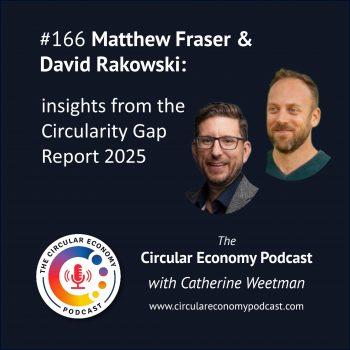
Matthew Fraser of Circle Economy and David Rakowski of Deloitte are two of the team behind the Circularity Gap Report, and we discuss some of the key insights from the 2025 report, published in early summer.
The Circularity Gap Report aims to provide a comprehensive ‘report card’ for the global circular economy, and shows that we are still a long way from achieving good grades.
Although the circular economy concept has gained traction—and more policies have emerged to support it—progress has stalled. You might remember the headline numbers from the first report in 2018, that the world was only 9.1% circular, described as a massive Circularity Gap. The gap has grown bigger, with the latest global circularity metric at just 6.9%.
Circle Economy sees a need for urgency: to expand access to its data and insights, dig deeper into what’s driving the decline, and to scale support for those in a position to make change happen.
Matthew Fraser is a recognised expert in the circular economy, with over a decade of experience advising governments on measurement and strategy. Matthew specialises in translating complex resource flows into actionable strategies, supporting governments in integrating circular principles into policy and investment decisions.
David Rakowski is a partner in Deloitte’s Sustainable and Resilient Supply Chain business with a focus on circular economy and sustainability. He began his career in sustainability over 10 years ago, and as a systems engineer by trade, he brings together product, business, supply chain and digital design to develop sustainable solutions.
We’ll start with a quick intro to the report’s origins and purpose, and the partnership between Circle Economy and Deloitte.
Matthew talks us through the key findings from the 2025 report, the challenges for policymakers, and the barriers and opportunities for businesses.
David unpacks some of the challenges for startups and big corporates, and the importance of making circular economy strategies both actionable and exciting.
And, we discuss how the shifting sands of resource availability, supply chain disruption and geo-economics are helping businesses see that circularity can boost resilience and reduce risks.
Podcast host Catherine Weetman helps businesses use circular, regenerative and fair solutions to do better, with less.
Stay in touch for free insights and updates…
Read on for more on our guest and links to the people, organisations and other resources we mention.
Links for our guest:
- Circularity Gap report 2025
- David Rakowski on LinkedIn
- Matthew Fraser on LinkedIn
- Circle Economy website
- Circle Economy’s social links: X; LinkedIn; Medium; Instagram
- Deloitte website
- Deloitte’s social links: Facebook; LinkedIn; X; Instagram; YouTube
Books, people and organisations we mentioned
- UN Human Development Index https://hdr.undp.org/data-center/human-development-index#/indicies/HDI
- IKEA and Globescan report – Ingka Group (IKEA) report: people are taking more climate action but feel it’s not enough: https://www.ingka.com/newsroom/ingka-group-ikea-report-people-are-taking-more-climate-action-but-feel-its-not-enough/
Guest bio
Matthew Fraser is a recognised expert in the circular economy, with over a decade of experience advising governments on measurement and strategy. At Circle Economy, he leads initiatives that provide policymakers with data-driven insights to assess circularity performance and identify high-impact opportunities for sustainable resource management. Matthew specialises in translating complex resource flows into actionable strategies, supporting governments in integrating circular principles into policy and investment decisions.
David Rakowski is a partner in Deloitte’s Sustainable and Resilient Supply Chain business with a focus on circular economy and sustainability. He began his career in sustainability over 10 years ago, and has led transformational projects across multiple sectors. As a systems engineer by trade, he brings together product, business, supply chain and digital design to develop sustainable solutions.
Circle Economy: We are a global impact organisation founded in 2011 as a cooperative. Today, we have grown into a team of 60+ experts who have worked with over 150 businesses, 55 cities and 27 nations around the world. It is our goal to double global circularity by 2032 to avoid climate breakdown. Together, we work toward this goal from the heart of Amsterdam. We believe that mainstreaming circular solutions is essential to live within the safe limits of the planet—for everyone, everywhere.
Deloitte provides leading professional services to nearly 90% of the Fortune Global 500® and thousands of private companies. Our people deliver measurable and lasting results that help reinforce public trust in capital markets and enable clients to transform and thrive. Building on its 180-year history, Deloitte spans more than 150 countries and territories.
If you’re new to the circular economy, you might like the ‘getting started’ playlist. There’s also an interactive podcast index, making it easy to find episodes on each of the key circular economy strategies or for a specific market sector. And to dig deeper, please check out Catherine’s award-winning A Circular Economy Handbook, published by Kogan Page.
Please follow the Circular Economy Podcast and let us know what you think on LinkedIn, and if you love this episode, please leave us a review wherever you listen, or send an email…